Addis Ababa at World Urban Forum 13
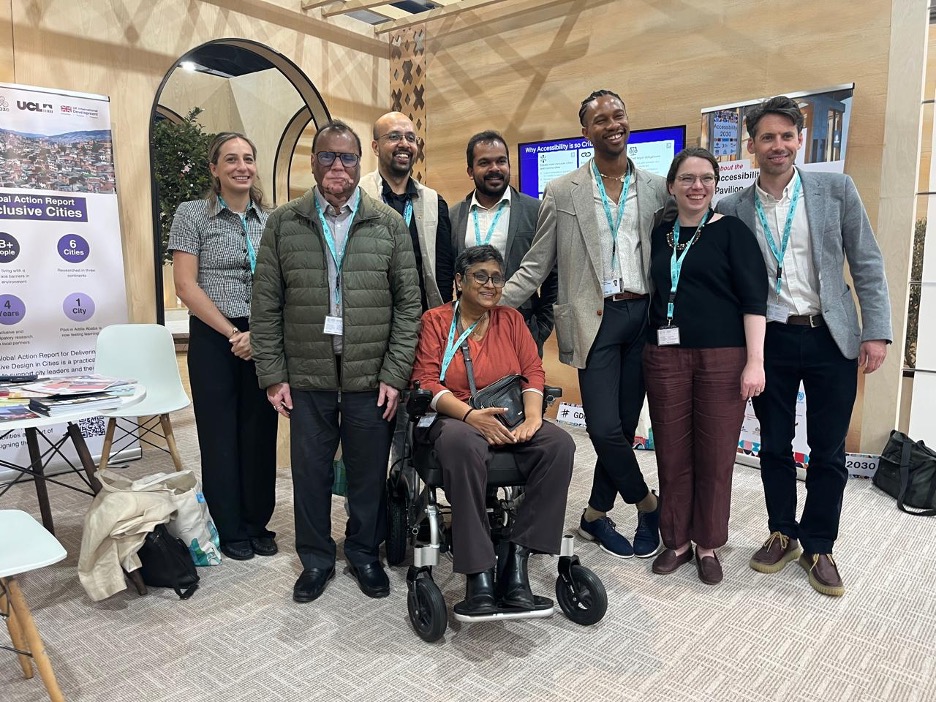
The World Urban Forum (WUF) is the premier global conference on sustainable urbanisation, convened by UN-Habitat to address the challenges and opportunities of rapidly growing cities. The Forum brings together governments, experts, civil society organisations, and communities to shape inclusive, resilient, and sustainable urban futures.
For the Global Disability Innovation Hub (GDI Hub), participation in the WUF is important for sharing our work and learning from others about inclusive cities. Considering our ongoing Inclusive City Pilot Project in Addis Ababa, this year we invited and supported the participation of Abayneh Gujo, Executive Director of the Federation of Ethiopian Associations of Persons with Disabilities, and Mahmoud Kedir Reshid, Persons with Disabilities Social Rehabilitation Senior Expert at the Ministry of Women and Social Affairs of Ethiopia, to accompany the GDI Hub delegation at World Urban Forum 13 in Baku, Azerbaijan.
The main objective was to bring voices from Addis Ababa to the global stage and contribute to international discussions on inclusive urban development. It also aimed to expose key Addis Ababa stakeholders to global innovations and experiences that they could take back and apply within their own city. Below is a brief conversation with them.
Tell us about your experience at WUF13 and what really impressed you?
Mahmoud
“My experience at the World Urban Forum has been incredibly inspiring. What stood out most was seeing people from around the world come together to share ideas and solutions that make cities more inclusive, liveable, and accessible for everyone, including persons with disabilities. It was encouraging to witness such strong commitment and collaboration toward creating cities that work for all communities.
I was also impressed by the hospitality, organisation, and accessibility throughout the Forum. As someone from Ethiopia, I kept reflecting on how these approaches and standards could strengthen accessibility efforts back home. Seeing environments organised to such a high standard showed what is possible and motivated me to consider how we can create similar inclusive spaces in our own context.
One thing that particularly stood out to me was how accessible the entire venue was. Moving around with my friend Abayneh, who uses a wheelchair, made me realise how much thought had gone into ensuring accessibility for everyone. That experience left a strong impression on me and made the Forum even more meaningful.
Abayneh
“I am very happy to be here, and I have learned a lot from attending the World Urban Forum. What impressed me most was the strong focus on accessibility and disability inclusion throughout the event. From accessible toilets and well-maintained facilities to the pavilion setups and information-sharing spaces, everything was thoughtfully organised.
I was also impressed by the volunteers, who were very well trained, supportive, and always ready to assist. The availability of personal assistance desks and the overall level of coordination showed a real commitment to inclusion. Seeing all of this has given me many ideas and lessons that I hope to take back home, especially as Ethiopia prepares for future global conferences and international events.
One thing that stood out to me was the large number of persons with disabilities attending the Forum. Despite the scale of the event, everything remained organised and accessible. It showed me that with proper planning and commitment, inclusion can truly be achieved. Ethiopia can learn a lot from this experience, especially as Addis Ababa continues to grow as a major diplomatic and conference city in Africa.
I am also grateful to the GDI Hub team for their support in ensuring I could fully participate in the Forum, including attending workshops and serving as a panellist. It has been a valuable and empowering experience for me. I was especially happy to be featured on Azerbaijan TV, where I had the opportunity to share my perspectives and learn from others as well.
Is there anything you feel should be improved? What are your biggest takeaways?
Mahmoud
“I think everything was very well organised for me, especially because this was the first high-level international event I have attended in person. The overall experience was extremely positive, and I was impressed by the level of accessibility and inclusion throughout the Forum.
Of course, there are always areas for improvement, such as having more sign language interpreters available for participants who rely on them. However, overall, the event created a very welcoming and inclusive environment.
This experience has given me many important lessons that I hope to apply in my own work. What stood out most was how people interacted with one another — everyone was respectful, supportive, and intentional about making others feel included and comfortable.
The way accessibility was integrated into the event, and how smoothly people could move from one place to another, showed that inclusive planning is truly possible when it is prioritised.
I have already noted many ideas and lessons that I want to take back with me, and I am grateful to have had the opportunity to be here and learn from this experience.”
Abayneh
“One of my major takeaways from this session was learning how carefully the event was designed to ensure inclusion from the beginning. Accessibility was considered in every aspect — from airport transportation, hotels, and venue access to the overall organisation of the event. It was clear that inclusion was treated as a core principle, not an afterthought.
I also had the opportunity to meet with the President of the Algerian Union of Persons with Disabilities. He explained that persons with disabilities and their organisations were actively involved in planning the event. Because of this participation, they now feel confident that everything is running smoothly. This reinforced an important lesson for me: meaningful participation of persons with disabilities in planning and decision-making is essential.
Another key takeaway was the strong budget allocation for accessibility and inclusion. I learned that the Azerbaijani government invested heavily in accessible information-sharing systems and disability-inclusive transportation. This made me reflect on Addis Ababa, where there is currently no fully accessible public vehicle operating citywide. If Ethiopia hopes to host major international events such as COP conferences, the Olympics, or international football tournaments, we must urgently improve accessibility.
Addis Ababa has a large population, and we need systems that can accommodate everyone equally, including persons with disabilities. Accessibility is also linked to our international reputation. For example, Ethiopian Airlines is one of Africa's leading airlines, but weak accessibility systems could negatively affect how the world sees us.
I also learned the importance of strong legal frameworks. Disability inclusion must be understood as a human rights issue, not a charity issue. We need to move away from medical approaches and adopt a rights-based approach that promotes social, economic, and political inclusion alongside accessibility.
Another impressive aspect was the information-sharing system. There was a dedicated television channel that provided event information in real time and in accessible formats specifically for persons with disabilities. In our context, information often reaches persons with disabilities too late, even when sign language services exist.
At the same time, I am concerned about how Ethiopia will strengthen coordination with UN agencies, NGOs, donors, and international partners if we host larger global conferences such as COP32. Hosting global public events requires accessibility not only for officials, but also for media, civil society groups, and independent participants from around the world.
Finally, although the organisers made significant efforts toward inclusion, there is always room for improvement. In disability inclusion, nothing is ever 100% perfect, but continuous improvement is important. For example, Organisations of Persons with Disabilities and regional disability networks could have had stronger visibility and representation within the event space.
Overall, this experience gave me valuable lessons that I hope to share with my government and other stakeholders back home to strengthen disability inclusion and accessibility in Ethiopia.”
Reflections for Addis Ababa and Other Global South Cities
Beyond the Forum discussions, these reflections strongly connect with Addis Ababa’s own urban transformation journey. Addis Ababa is a city undergoing rapid transformation, and its experiences offer important lessons for other cities across the Global South.
According to the city government, five key lessons from the Addis Ababa regeneration model include:
- Preparing for rapid urbanisation while undergoing large-scale transformation.
- Demonstrating that cities can transform despite significant social and economic challenges.
- Ensuring strong political leadership and commitment to drive meaningful change.
- Shifting from aid dependency toward investment-led transformation. Addis Ababa, as an autonomous city, has reportedly mobilised more than 3.2 trillion Birr through partnerships with private-sector actors, micro-enterprises, and SMEs, creating a model that engages a broad range of stakeholders.
- Creating inclusive projects that benefit everyone, including persons with disabilities and other marginalised groups.
The participation of Ethiopian disability leaders at WUF13 highlighted the importance of inclusive urban development, accessibility, and international collaboration. Their reflections provide valuable lessons not only for Addis Ababa, but also for cities across the Global South seeking to build accessible, inclusive, and sustainable urban futures.