Generate new evidence & insights.
We answer critical research questions and develop foundational methodologies, addressing intersectional challenges and research and evidence gaps. Led by GDI Hub at University College London, with academic and community partners globally, this cluster will answer critical research questions and develop foundational methodologies to support the evidence base for best practices in assistive technology provision in low- and middle-income countries.
Sub-Programmes
- Data and Evidence Portal: Our Data and Evidence portal combines research from the Rapid Assessments of Assistive Technology and various global studies. The portal aims to improve access to life-changing assistive technology for all by providing access to data and evidence for government policymakers, INGOs, OPDs, and specialised agencies, enabling informed, evidence-based decisions.
- What Works: Wrap around, programme wide research across the entirety of the AT2030 programme using an interactive, responsive methodology which builds realist analysis to identify the underlying generative causal mechanisms that explain how outcomes were caused and how context influences these outcomes and is designed for programmes that are complex.
- Mobile & Emerging Technology: Mobile and emerging technologies are enhancing assistive devices with features like text-to-speech and eye-gaze control, improving accessibility. The ‘Mobile as AT’ project has influenced mobile phone developers to improve accessibility and is informing other programmes, such as FCDO’s AI for Development (AI4D). Building on this learning, the Centre for Digital Language Inclusion (CDLI), co-funded by Google.org, is now harnessing the power of AI and the potential of communication solutions to change lives. The CDLI is developing inclusive solutions for people with communication difficulties and trains people how to use them. They are collecting datasets of non-standard speech to build Automatic Speech Recognition models, enabling disabled people with communication barriers to take advantage of Automatic Speech Recognition software.
Latest
-

Dot Glasses Field Trial Template Pack
Dot GlassesJuly 8, 2026KenyaAT2030 ResourcesDot Glasses Field Trial Template Pack
-
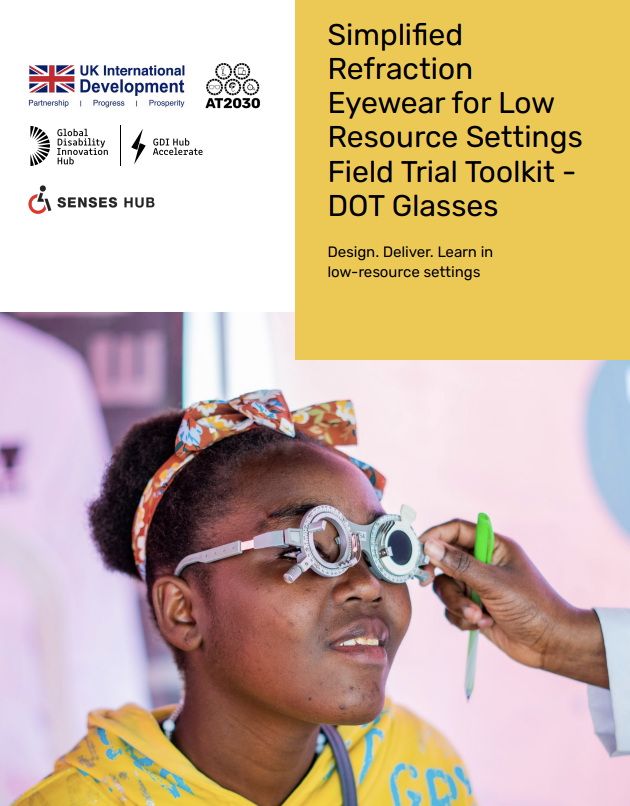
Simplified Refraction Eyewear for Low Resource Settings Field Trial Toolkit.
Dot GlassesJune 30, 2026KenyaCase Studies and ReportsThis toolkit is a practical guide for delivering simplified refraction eyewear in low-resource settings. It draws on a field trial conducted across seven community sites in Nairobi and Kiambu Counties in June August 2025. It is designed to help teams: • deliver vision camps safely and efficiently • maintain protocol and data quality • generate evidence that supports real decisions about scale. This toolkit focuses on how to deliver. It covers field operations, ethics and safeguarding, monitoring, and partner roles, based on what worked in practice.
-
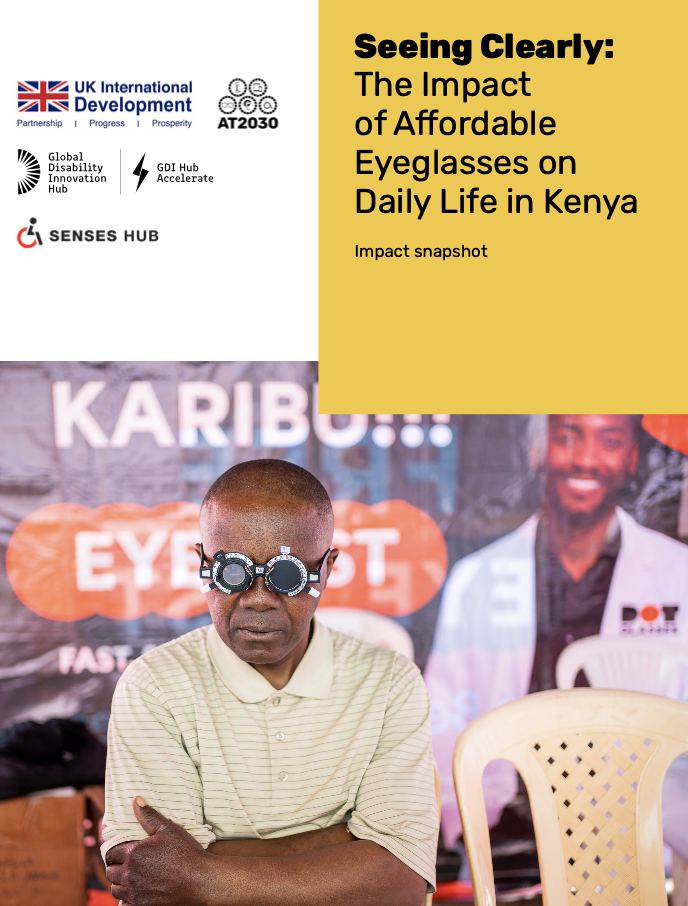
Seeing Clearly: The Impact of Affordable Eyeglasses on Daily Life in Kenya
Dot GlassesJune 29, 2026KenyaAT2030 ResourcesThe report draws on survey, questionnaire, and interview data from people who received eyeglasses through the trial. Participants reported meaningful improvements in daily activities such as reading, phone use, schoolwork, and mobility, alongside increased independence and confidence. Experiences were not uniform: some participants reported discomfort or more modest benefits, and a small minority reported no improvement or reduced independence
-
Simplified Refraction Eyewear for Low Resource Settings Field Trial Toolkit - DOT Glasses
Global Disability Innovation Hub, Dot Glasses, Senses HubJune 25, 2026KenyaCase Studies and ReportsThis toolkit is a practical guide for delivering simplified refraction eyewear in low-resource settings. It draws on a field trial conducted across seven community sites in Nairobi and Kiambu Counties from June to August 2025. It is designed to help teams: • deliver vision camps safely and efficiently • maintain protocol and data quality • generate evidence that supports real decisions about scale. This toolkit focuses on how to deliver. It covers field operations, ethics and safeguarding, monitoring, and partner roles, based on what worked in practice.
-
A review of assistive product prices in 12 countries
Johan Borg, Irene Calvo, Vinicius Delgado RamosApril 29, 2026GlobalAcademic Research PublicationsThe World Health Organization (WHO) and the United Nations Children's Fund (UNICEF) estimate that over 2.5 billion people need assistive technology, yet access remains limited. In response to this pressing need, WHO has maintained, since 2016, a Priority Assistive Products List (APL) with 50 priority assistive products. In 2024, an update was launched to revise and expand the list based on new evidence and stakeholder input. This paper presents the price review component of the update. The review consisted of collecting global price data and classifying assistive products into price ranges to support the decision-making process for the updated APL.