Beyond access, beyond impact – what about ‘lifechanging’ AT?
Dr Ellie Cole (she/her), Professor Sylvia Esther Gyan, Dr Ernestina Tetteh, Ms Gifty Ayoka
What happens when someone receives assistive technology (AT)? The impact of AT is often only thought of as changes in functioning. This impact, while clearly important, may not capture the whole story. Another question which is asked less often: does the AT help the person to do what matters most to them? Does it enable them to achieve their goals and aspirations?
We are therefore asking a simple question: how does AT become lifechanging?
What are we doing?
The Global Disability Innovation (GDI) Hub is working on a research project in partnership with the University of Ghana and the Talking Tipps Foundation to answer this question. This research is part of AT2030.
AT2030
The AT2030 programme tests ‘what works’ to get assistive technology to the people who need it the most. It seeks to transform access to lifechanging AT through creating partnerships, testing and investing in AT innovations, and research to answer critical research questions. AT2030 is being led by the GDI Hub and funded by UK International Development. By 2030 we will directly reach over 9 million people in more than 45 countries.
In February 2026, we spoke to AT users and caregivers in the capital city Accra and in Ho, a town in the Volta region. We asked AT users, their parents/caregivers, and professionals their opinions about what ‘lifechanging AT’ means. We used a range of methods, including interviews, workshops, focus group discussions, and life timeline drawings to get in-depth insights from multiple perspectives.
AT in Ghana
In Ghana, an estimated 2.1 million people live with some form of disability, many of whom would benefit from one or more assistive devices. Cost is often a barrier to people, as AT is not usually covered in the national health insurance, which means that many people pay out-of-pocket for devices that are often expensive to import as local production of devices is very limited. In addition, stigma associated with AT can be a deterrent to people using devices that they might benefit from.
The situation is starting to change. The current government has reconfirmed its focus on improving access to AT and service provision through national policy initiatives and international programmes. However, there are still significant gaps in the availability, affordability, and sustainability of AT provision. There remains limited training or continuing professional development on AT, meaning that both service providers often also lack knowledge about what AT is available. In addition, a fragmented service delivery system, compounded by insufficient numbers of trained personnel, means that people often still struggle to access the AT they need.
What are we finding out?
This project is still ongoing, but emerging information is already showing some interesting avenues for further exploration. This simple question was deceptively difficult to answer, with surprising and nuanced responses.
Stories of success
There are stories of achievements. People spoke about their AT making it possible to complete education, learn a trade, or start a business. Many said that without the AT they just would not have been able to achieve their aspirations. A man with a visual impairment said that learning to use Braille, ‘made me feel human’, and children with visual impairments spoke of the world ‘opening up’.
AT changed every aspect in my life. Before using the wheelchair I thought I am not a complete being… [now] I accept who I am, all because of the wheelchair… it changed my inner man - man with a physical impairment, Ho
Sometimes what appear to be small things can be lifechanging for people. Some people talked about AT making it possible for them to cook and to contribute to household chores. Caregivers spoke of the easing of some responsibilities, having more time to do things. Lifechanging wasn’t always about more ‘traditional’ AT. Some users with visual impairments spoke of using Uber making it possible to be independent.
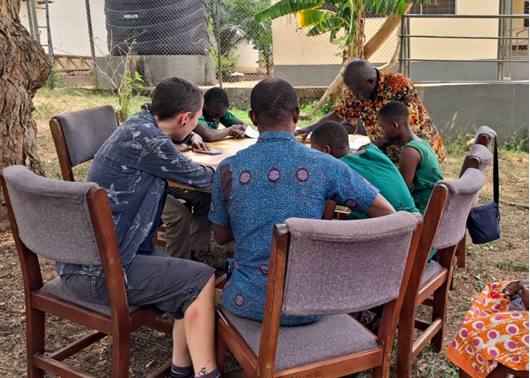
Child ‘most significant change’ game. Photo credit: Dr Ernestina Tetteh, University of Ghana
Stories of limitations
But we are also finding things that constrain or limit AT’s lifechanging potential, and that the challenges that people face may not be solved by AT alone.
Environmental factors were a particularly frequent challenge. Poor road surfaces and open drains were regularly mentioned by both people with visual and physical impairments as barriers to their independence.
Poor attitudes also limited the potential of AT to be lifechanging. A child with a visual impairment told us that, which meant that she still relied on other people to help her cross roads.
People don’t respect the white cane - young woman with a visual impairment, Ho
There are also ongoing costs and access challenges that constrain AT’s lifechanging potential. For example, a mother of a child with a hearing impairment told us that getting new batteries for her child’s hearing aids wasn’t just a question of money (which did play a role), but the batteries themselves were not easy to find. As hearing aid batteries sometimes last for as little as six weeks before they need replacing, access and affordability were a constant struggle.
Stories of complexity
As we delve deeper, the information becomes even more nuanced. We are starting to find that understandings of ‘lifechanging’ can be relational. We spoke to parents and caregivers in focus group discussions. From their perspective, what might be lifechanging about AT did not always translate into change for them. For example, one caregiver spoke about his AT user, who had acquired a wheelchair. The wheelchair user himself felt that this was transformational. However, the user was still not completely independent, and the caregiver still had to accompany him, which did not remove caregiving responsibilities, despite mobilisation being substantially easier.
In addition, external factors may mediate what lifechanging means. One parent said that while the wheelchair had been transformative for her child and she was now able to attend school, she could not afford the feeding fees. This meant that her child remained out of class, curtailing what could be ‘lifechanging’ potential.
What next?
The data collection in February ended with a knowledge-sharing workshop, which brought together representatives from organisations of people with disabilities, non-governmental organisations, AT practitioners and users themselves, to discuss these emerging themes. This event, which was attended by more than 20 people, was an opportunity for people to feed back on our initial findings
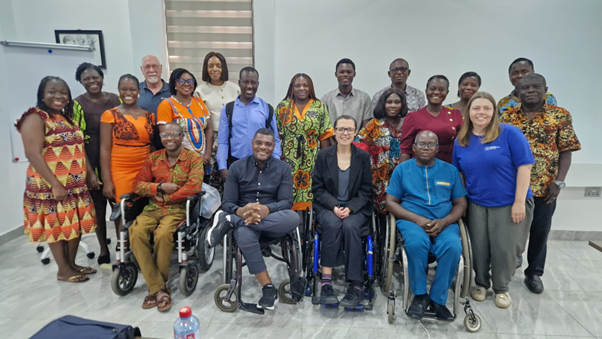
Knowledge-sharing workshop participants
Next, we are starting an in-depth analysis of the data.
Answering the question ‘what makes AT lifechanging?’ is already revealing the complexities of people’s experiences and perspectives about what impact means in Ghana. We will also conduct this research in Nepal, creating an opportunity for a cross-country comparison. This will help us to understand if people in different contexts have similar opinions, or whether their experience, shaped by very different systems and environments, change their understanding of what ‘lifechanging AT’ means?