Co-Creating Inclusive and Resilient Cities: The Way Forward from COP-30 [Disability, Climate & Cities blog series]
Back in November 2025, at COP-30 in Belém, Brazil, Global Disability Innovation Hub (GDI Hub) brought disability inclusion to the centre of the urban climate resilience agenda—co-hosting an expert dialogue, publishing new evidence, and sharing practical pathways for cities to act now.
Throughout our engagement across the summit, our message was clear: inclusive design and innovation as a mindset and methodology are key to implementing climate solutions that work for all, including people with disabilities, and co-creating resilient urban futures.
This was the third COP GDI Hub has participated in. Our continued contribution to the discussions on disability-inclusive climate solutions, act to both streamline our work and to strengthen the evidence for inclusive climate action globally. In this blog, we share more on our role at COP-30 and the research and evidence contributed.
Advancing an inclusive transition
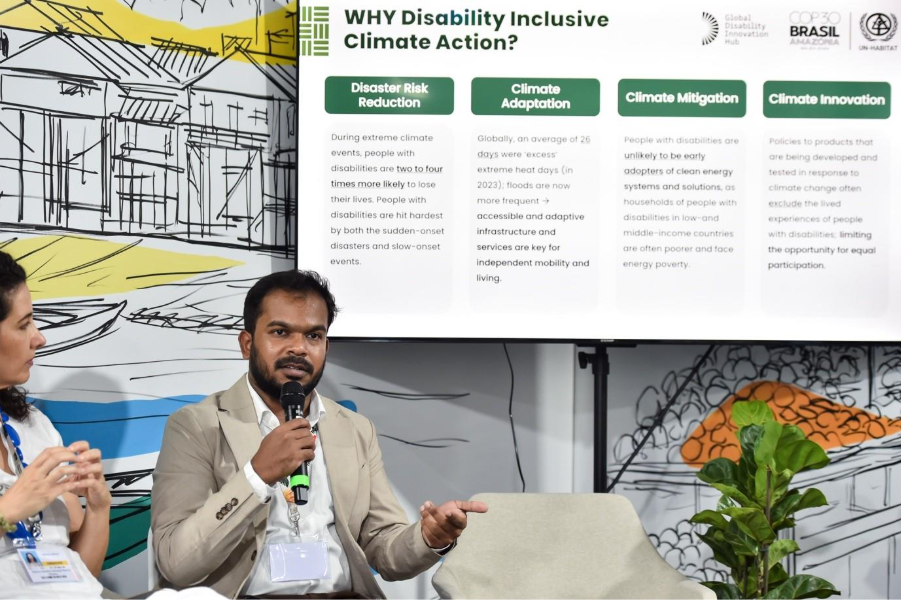
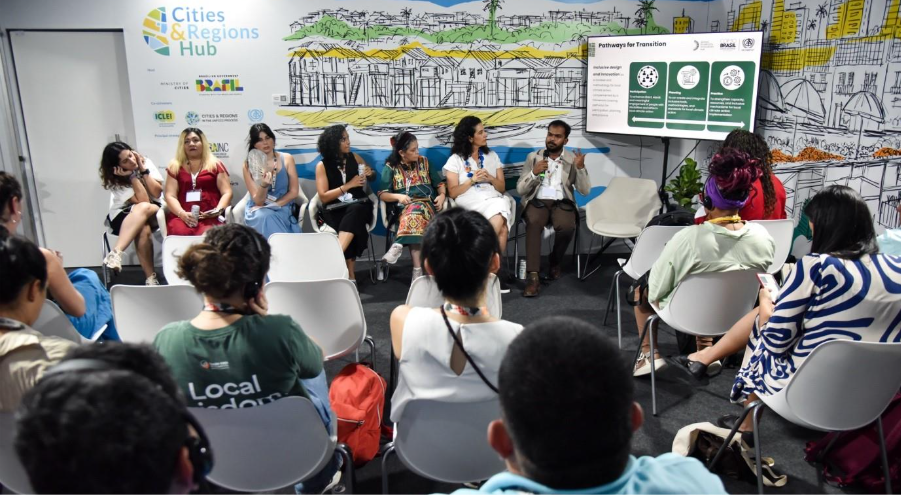
GDI Hub co-hosted a side-event titled Caring and Resilient Cities: Advancing a Green, Feminist, and Disability Inclusive Urban Transition alongside UN Habitat and the Alziras Institute at the Cities & Regions Hub. The panel highlighted care, accessibility, and participation as pillars of a just transition agenda, drawing from gender equality and disability inclusion perspectives. GDI Hub’s, Inclusive Climate Researcher, Bala Nagendran presented our approach to supporting cities and communities in collaboratively planning and implementing disability-inclusive climate action, including showcasing evidence from our UK International Development funded AT2030 programme. Bala stressed the need to embed the lived experiences of diverse disabilities in shaping inclusive and low-carbon climate innovation for cities.
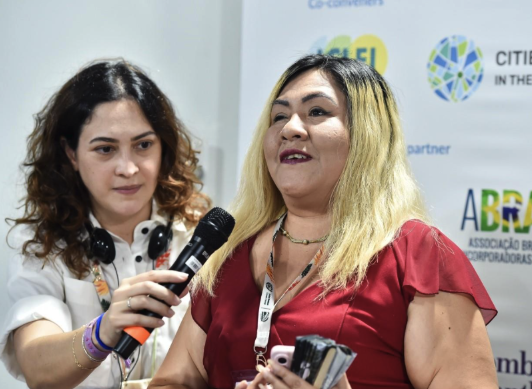
Speaking at the session, Rosa María Juarez Cobeñas, Secretary of Technology and Accessibility of the Latin American Network of Organizations of Persons with Disabilities and Their Families (RIADIS), emphasised the significance of accessibility in ensuring equitable climate benefits, particularly for women with disabilities.
The Cities & Regions Hub at COP-30 acted as a platform for multilevel action — linking local priorities to global negotiations and co-convened by UN-Habitat and ICLEI and hosted by the Ministry of Cities of Brazil. By highlighting the disproportionate climate risks being faced by people with disabilities living in cities, GDI Hub reinforced the urgency in co-creating inclusive tools and methodologies for localising climate action.
Building a Case for Disability-Inclusive Local Climate Action
With over one billion people with disabilities projected to live in cities by 2050 and more than 150 cities having verified Paris Agreement-compatible climate action plans, there is a clear need and opportunity to integrate urban inclusion and resilience measures. During COP-30, GDI Hub published a white paper on “Building a Case for Disability Inclusive Local Climate Action.”
This paper presented consolidated evidence of how climate impacts can threaten disability rights and the principles and opportunities for disability-inclusive urban climate action. The white paper also proposes a conceptual action framework for cities and communities, covering participation, planning, and practice pathways, established from GDI Hub’s ongoing multi-city research at the intersection of disability rights, urban development, and climate action, under the AT2030 programme.
Read the White Paper: Building a Case for Disability Inclusive Local Climate Action
Accelerating inclusive urban infrastructure through Gender Equality, Disability, and Social Inclusion GEDSI
During a second side event — Building Resilience for All: Integrating GEDSI into Infrastructure, (co-hosted by the International Coalition for Sustainable Infrastructure (ICSI), the Coalition for Disaster Resilient Infrastructure, and the Global Covenant of Mayors for Climate & Energy (GCoM)) - we shared key findings from GDI Hub’s AT2030 Inclusive Cities research and highlighted recommendations from the Global Action Report. This research identified the importance of considering climate action within inclusive city planning and how integrating Gender Equality, Disability, and Social Inclusion (GEDSI) across planning, procurement, design, operations, and maintenance strengthens inclusive and resilient outcomes for people and urban systems.
“As more cities are creating climate action plans, we need disability-focused or -targeted climate policies and programmes. This is key to strengthening disability confidence among local governments and ensuring people with disabilities aren’t left behind when applying the GEDSI framework.” Bala Nagendran M, Inclusive Climate Researcher, GDI Hub
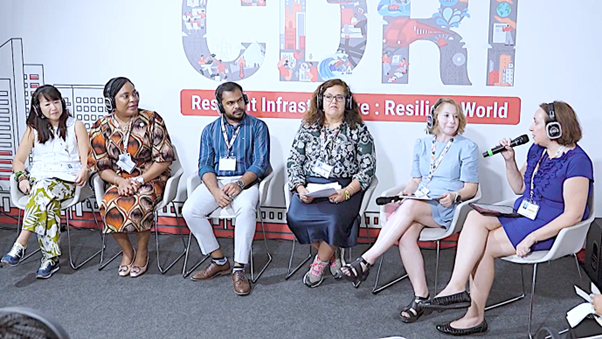
Our “Delivering Inclusive Design in Cities: A Global Action Report”, combines four-years of research across six cities in low- and middle-income countries, was also featured in “The Climate Resilient Infrastructure Report: A Focus on Gender Equality, Disability and Social Inclusion”. Published at COP-30, the report was co-developed by the International Coalition for Sustainable Infrastructure (ICSI) and the Coalition for Disaster Resilient Infrastructure, a deliverable for the Climate High-Level Champions #RacetoResilience campaign and is supported by the Global Covenant of Mayors for Climate & Energy (GCoM).
Way Forward
GDI Hub first participated at COP in 2021 at COP-26 in Glasgow, where we held an event in partnership with the UK FCDO and Asian Development Bank on Disability Inclusive and Resilient Cities. Our two ongoing research activities are focusing on addressing the evidence gaps highlighted in these forums to support practitioners with disability inclusion within climate solutions.
- “Disability-inclusive Solutions for the Climate Crisis: Leveraging Urban, Infrastructure, and Assistive Technology Research,” in partnership with the UCL Bartlett Development Planning Unit, funded by the UK International Development (AT2030 Programme) and UCL Grand Challenges. Read about our climate roundtable, hosted as part of this research, during the London Climate Action Week.
- “State of Disability Inclusion in Local Climate Action and the Pathways for Transformation,” funded by the UK International Development (AT2030 Programme). This will bring together insights from people with disabilities, climate practitioners, OPDs, and climate action plans from thirteen cities across the globe.
As we prepare for the 13th World Urban Forum, our upcoming blogs will cover findings from these research projects and updates from GDI Hub’s Inclusive Cities pilot project at Addis Ababa, funded by the AT2030 Programme and Global Disability Fund.