Mobile & Emerging Technology
Mobile and emerging technologies are enhancing assistive devices with features like text-to-speech and eye-gaze control, improving accessibility. However, questions persist about the effectiveness of mobile devices as assistive technology.
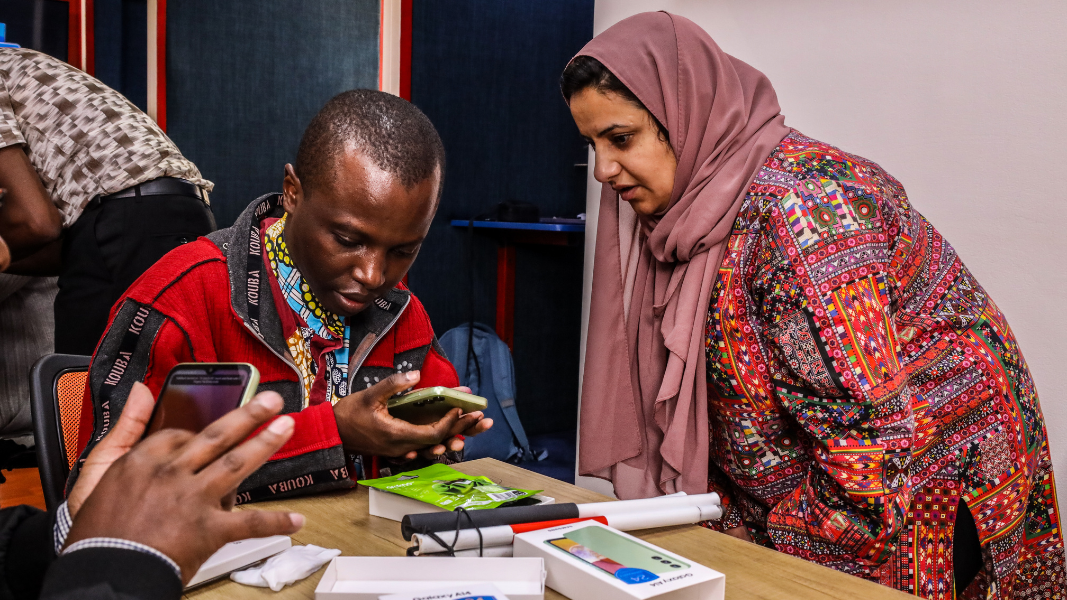
Mobile and emerging technologies are shifting the landscape of assistive technology.
Previously expensive assistive devices were required for text-to-speech technology, for example, eye-gaze control. However, increasingly, these technologies are embedded into mainstream devices. This is exciting. What we don’t yet know, though, is how far a mobile device can act as an assistive technology, how will be people learn about novel accessibility features and be trained to use these, and what impact can mobile and emerging technology have on disabled people’s quality of life. We focus these questions on people living in low- and middle-income countries.
We previously designed and implemented GSMA’s first mobile disability gap and the first digital product narrative.
We are now focussing on two projects:
- Mobile as AT
- Project My Voice, My Words!
Mobile as AT
How can mobile phones be assistive technologies for people in low- and middle-income countries? We've worked alongside 800 disabled people in Brazil, Kenya and India with hearing and visual impairment to test the use and impact of Android devices as a form of AT. AT2030 has funded the core research with matched funding from ATscale, alongside an unrestricted gift from Google. The project is led by GDI Hub at UCL Computer Science with academic, mobile and community partners in Brazil, Kenya and India.
Results and outputs
- find out about this work in Kenya
- Read the Kenya report in full
- find out about our policy recommendations
- Read the Mobile Policy Note
Project My Voice, My Words!
In countries like Ghana, people with communication difficulties that lead to non-standard speech are not easily understood. This community are often excluded from society due to:
- Speech and Language Therapy (SLT) services
- Poor availability of assistive technologies to support communication
- Stigmatizing cultural beliefs.
We initially conducted a six-week study of Relate, a free-to-use application launched by Google in Ghana. Relate uses bespoke language models and Automatic Speech Recognition (ASR) to communicate with people with non-standard speech. We found people wanted to speak their language and their own words, so we developed Project My Voice, My Words! as a collaboration between UCL, GDI Hub, and the University of Ghana. It is expanding to support the collection of non-standard speech in Ghanaian languages in partnership with the University of Ghana and research in Nigeria, Kenya, and Rwanda. This work is now partially funded by an unrestricted gift from Google.
Partners
-
UCL Computer Science
-
UCL GDI Hub
-
GDI Hub CIC
-
Google (matched funder)
-
ATscale (matched funder)
-
IIIT Bangalore
-
Vision Empower
-
Keio University
-
University of Sao Paulo
-
Claro (mobile internet partner)
-
Safricom (mobile internet partner)
-
GSMA
Team
- Dr Giulia Barbareschi, Keio University
- Dr Richard Cave
- Ms Gifty Ayoka
- Mr Derick Omari
- Mr Lan Xiao
- Mr Raul Szekely
- Dr Mwangi J Matheri
- Philip Oyier School of Computing and IT, Jomo Kenyatta University of Agriculture and Technology, Nairobi, Kenya
- Henry Athiany Department of Statistics and Actuarial Sciences, Jomo Kenyatta University of Agriculture and Technology, Nairobi, Kenya
- Dr Wallace M Karuguti Department of Rehabilitation Sciences, Jomo Kenyatta University of Agriculture and Technology, Nairobi, Kenya
- Dr Mwangi J Matheri MJM Department of Rehabilitation Sciences, Jomo Kenyatta University of Agriculture and Technology, Nairobi, Kenya
- Raul Szekely University College London, London, United Kingdom
- Clara Aranda, GSMA
- Michael Nique, GSMA
- Jenny Casswell, GSMA
Publications
- Enhancing Communication Equity: Evaluation of an Automated Speech Recognition Application in Ghana (best paper award)
News and Blogs
Latest
-
Toward a Multi-layer Framework to Assess the Quality of Life Impact of Smartphones as Assistive Technology for People with Sensory Disabilities in Kenya
Vicki Austin, Catherine Holloway, Dr Giulia Barbareschi, Lan Xiao, Maryam BandukdaOct. 22, 2025KenyaAcademic Research PublicationsRecent advances in smartphone technology have elevated their potential as digital assistive technologies (AT) for blind or partially sighted (BPS) and deaf or hard of hearing (DHH) individuals. However, there is a gap in fully understanding the use of smartphones as AT and their impact on the quality of life (QoL) of BPS and DHH individuals. To address this gap, we conducted a mixed-methods longitudinal study over six months with 193 participants in Kenya. The study involved a baseline survey, smartphone digital skills training, and a follow-up survey and interviews to examine the impact of smartphones as AT. The findings emphasise the significant impact of smartphones on their quality of life, including impact on their identity and well-being, social inclusion and leisure, access to information and education, and material well-being. Building on the findings, we contribute an AT Impact Framework, which highlights the behaviours enabled by smartphones and their impact on the individual
-
A Cookbook for Community-driven Data Collection of Impaired Speech in LowResource Languages
Gifty Ayoka, Catherine Holloway, Richard CaveSept. 30, 2025GhanaAcademic Research PublicationsThis study presents an approach for collecting speech samples to build Automatic Speech Recognition (ASR) models for impaired speech, particularly, low-resource languages. It aims to democratize ASR technology and data collection by developing a "cookbook" of best practices and training for community-driven data collection and ASR model building. As a proof-of-concept, this study curated the first open-source dataset of impaired speech in Akan: a widely spoken indigenous language in Ghana. The study involved participants from diverse backgrounds with speech impairments. The resulting dataset, along with the cookbook and open-source tools, are publicly available to enable researchers and practitioners to create inclusive ASR technologies tailored to the unique needs of speech impaired individuals. In addition, this study presents the initial results of fine-tuning open-source ASR models to better recognize impaired speech in Akan.
-
Exploring the Usability of Gaze-based Mobile Communication in Ghana
Gifty Ayoka, Vicki Austin, Catherine Holloway, Dr Giulia Barbareschi, Richard Cave, Derick OmariSept. 26, 2025GhanaAcademic Research PublicationsIn Ghana, people with communication challenges could benefit from gaze-based Augmented and Assistive Communication devices (AACs), widely used in countries with greater resources. However, there is limited evidence about the potential of such devices by people with communication disabilities in the Global South. Our study sought to evaluate the usability, identifying barriers and facilitators of adoption of a freely available Android-based eye-gaze AAC application called Look to Speak. The study included training of 10 local speech and language therapists and 15 people with communication difficulties. Our findings highlight how, despite some initial successes and the positive opinions of clients, caregivers and speech and language therapists the Look to Speak application largely failed to deliver substantial communication benefits to individual users. This was due to a combination of factors including the high cognitive load, design flaws of the application - such as the lack of optimi