Making Our Way Out of the Heat: Co-Designing Inclusive and Resilient Infrastructure
“How hot does it feel there?” was a common opening question in almost all our calls until a few weeks ago.
With predictions for a more intense El Niño (a natural climate pattern that raises the surface water temperatures in the Pacific Ocean and drives hotter weather conditions globally) between October and December 2026, this blog is a reminder of the challenges at the intersection of climate risks, urban infrastructure, and disability, and the need to collaborate and co-design. This draws on GDI Hub’s recently published Inclusive Climate Infrastructure Design Playbook.
June 2026 was the second-warmest June on record globally. London hit 35.8°C on 24 June, New York City recorded 38°C on 2 July, New Delhi recorded 43.5°C in mid-June, and Karachi’s daytime temperature peaked at 46°C in May. Photos and video clips of residents scrambling to buy air conditioners, sweltering Tube passengers, delayed public transport services, and people seeking respite in open-air public spaces went viral.
But what do these numbers and visuals really mean? Our homes are not equipped to keep us comfortable throughout the year. Moving around the city using sustainable modes of transport can become more challenging. Public green spaces offer refuge and relief but are insufficient. Most importantly, heat is no longer just about comfort; it directly impacts lives. Heat is deadly; recent research estimates 489,000 heat-related deaths every year, with 45% of them in Asia and 36% in Europe.
And how does this intersect with disability? The quotes below present the lived experiences of persons with disabilities under extreme heat conditions.
“…not sick enough to be admitted to the hospital, but… I'm completely uncomfortable in my own self.” – an adult wheelchair user from Mumbai, India
“…it was insanely hot on the commute home, and it almost immobilised me.” – an adult living with epilepsy in London, UK
In a predominantly inaccessible world, where persons with disabilities face numerous barriers to independent living, good health and well-being, and equal participation in urban life, rising temperatures are an added burden that compounds risks and inequalities. This makes co-designing the urban built environment both a priority and an opportunity, as persons with diverse disabilities often have differential experiences of heat and other climate risks, which are unaccounted for in conventional design processes of everyday spaces as well as wider systems of infrastructure and services. We need methods and mechanisms that simultaneously deliver inclusion and resilience under rising climate risks, particularly for persons with disabilities. GDI Hub proposes Inclusive Climate Infrastructure Design as an approach to putting this into practice.
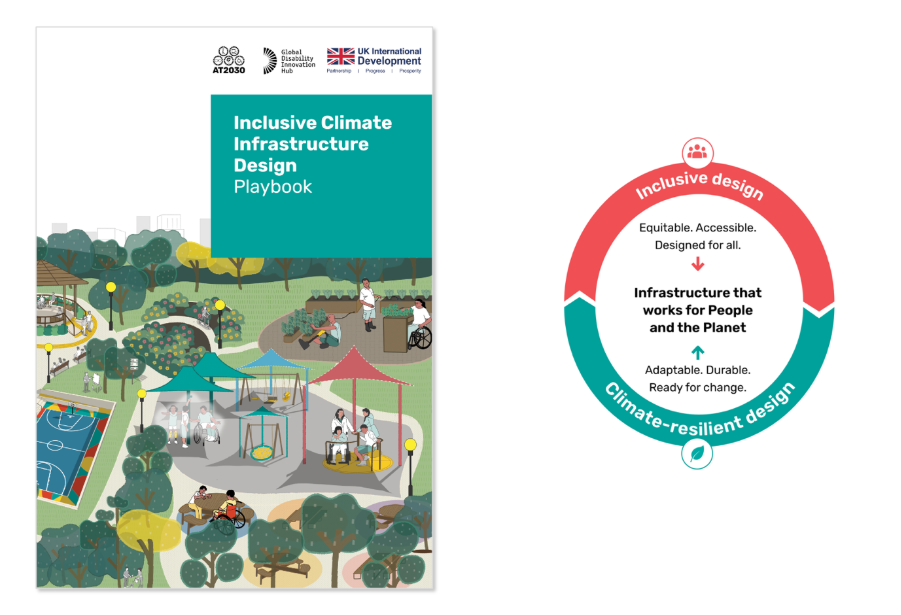
Cover page of the Design Playbook and the Inclusive Climate Infrastructure Design graphic
Building on multi-year inclusive design research and practice, and through a combination of a desk review of over 50 inclusive climate infrastructure projects globally, key informant interviews with 17 project stakeholders, and participatory workshops with over 25 experts, GDI Hub has prepared and published the Inclusive Climate Infrastructure Design Playbook, under the UK International Development-funded AT2030 programme.
The Playbook offers insights and inspiration about how to design housing, transport, and public spaces that are disability-inclusive and climate-resilient. It is a knowledge resource for urban and built environment designers and practitioners, inclusive designers, climate practitioners, and city authorities who are shaping urban infrastructure policy and implementation. The Playbook will also serve as an advocacy and learning tool for persons with disabilities, Organisations of Persons with Disabilities (OPDs), civil society organisations (CSOs), and development organisations.
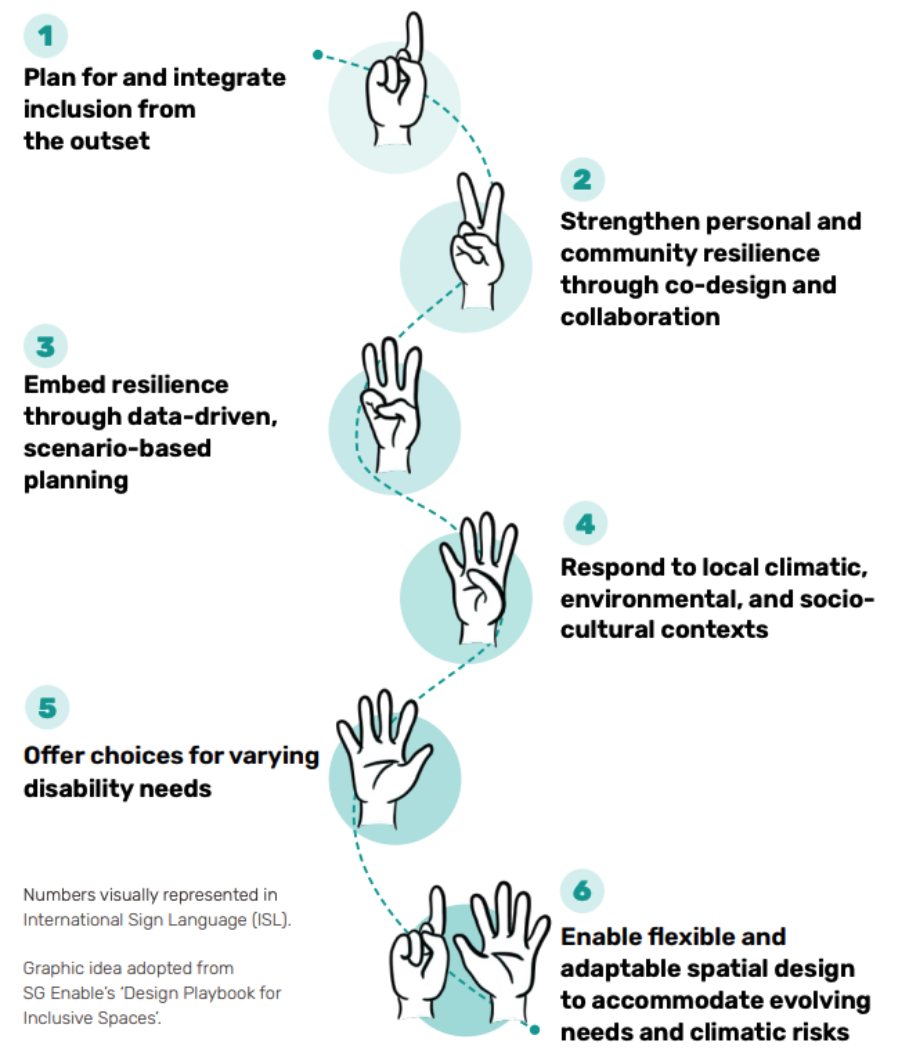
Six guiding design principles
The Playbook presents guiding design principles and foundational actions for inclusive climate infrastructure design and illustrates key recommendations for the three above-mentioned built-environment sectors.
Alongside multiple climate risk scenarios, including flooding, hurricanes, and storms, the Playbook covers recommendations to strengthen heat resilience, such as passive design for homes to maintain comfortable indoor temperatures, shade and water spray features for public spaces, and durable and user-friendly materials for sensory comfort. Covered accessible parking spaces, air-conditioned low-floor electric buses, shaded pathways, heat-block coated accessible outdoor furniture, and step-free mist tents are some specific solutions illustrated in the Playbook. These measures are particularly important for supporting the well-being of children with disabilities, who may experience heightened risk during heatwaves due to impaired thermoregulation, communication barriers that prevent them from expressing thirst or discomfort, and side effects from medications.
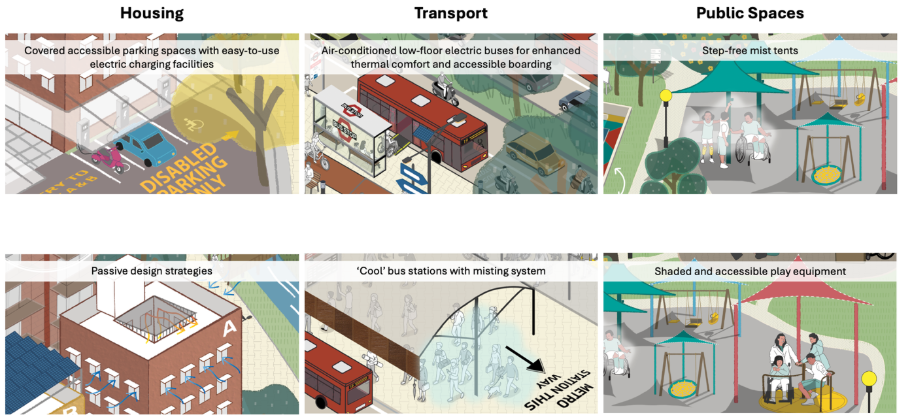
Heat-resilient design solutions by sector
Cities globally are responding to the call to heat action through a diverse range of interventions: London has launched a Heat Ready plan; New York City now has a Cool Options map for citizens to spot spaces with air-conditioning; the Chicago Park District has announced $1 million for cooling enhancements at 42 park sites; and over 30 cities are engaging through the C40 Cool Cities Accelerator. Cities in low- and middle-income countries are making commitments, but planning, investment, and delivery are still largely absent.
The big question from us at GDI Hub: Are these commitments, plans, and investments inclusive of the needs of persons with disabilities?
For example, New York City’s Cool Options map does not indicate the accessibility features available at the sites, and the Heat Ready plan for London mentions disability just once, in relation to using an existing grant to reduce home overheating.
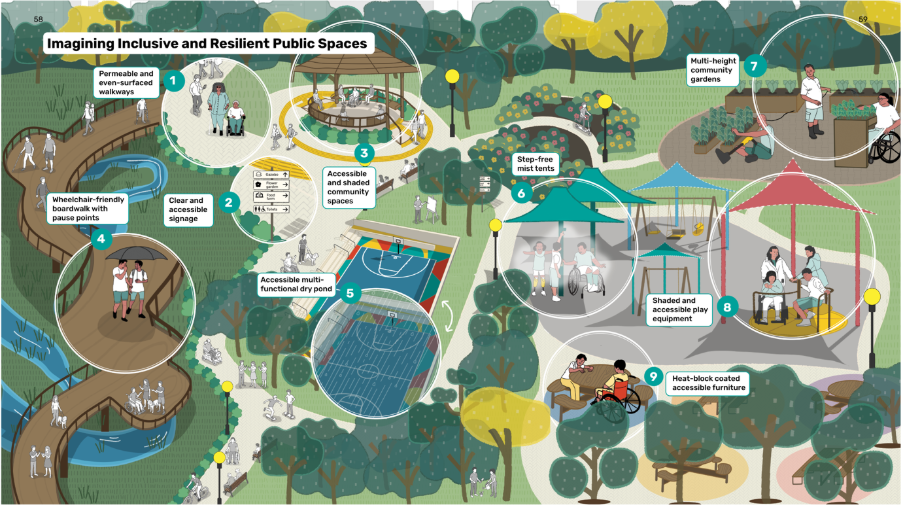
Imagining inclusive and resilient public spaces
We believe the Playbook is a starting point. It will foster imagination, creativity, and ambitious thinking about how best to deliver essential urban infrastructure that maximises the inclusion of persons with disabilities and improves their resilience to climate risks.
To enable the transition from playbook to practice, GDI Hub hosted a public webinar as part of the 2026 New York City Climate Week. Through a combination of presentation, panel discussion, and participants’ reflections, the session brought out insights on what it takes to engage persons with disabilities and influence infrastructure planning processes in cities.
When asked to share one action to embed inclusion and resilience in urban infrastructure design and delivery, the panellists recommended that the practitioners and city governments should:
- Engage persons with disabilities from the outset and keep them involved throughout the project — Loise Kinyua, Disability Rights Advocate, Board Member – United Disabled Persons of Kenya (UDPK)
- Change mindset from compliance-based accessibility to outcome-based accessibility — Anton Siura, Siura Studio
- Recognise and respond to urban informality, from both built environment and socio-economic participation lenses — Ariana Karamallis, Director of Global Engagement, Build Change
Way Forward
- Complementing the Playbook, GDI Hub is now developing a companion set of case studies to spotlight real-world examples of disability-inclusive and climate-resilient infrastructure, spanning a range of scales and typologies and drawn from urban areas facing diverse climate risks.
- Through the AT2030 programme, GDI Hub will lead deep-dive heat action research to strengthen evidence from the lens of lived experiences of persons with diverse disabilities and test design solutions.
Call to Action
We hope to expand this work across other urban sectors, including energy, water, sanitation and hygiene (WASH), food, and healthcare.
If you are working in urban climate infrastructure sectors or know of impactful projects or solutions that combine inclusive design and resilience considerations, share your insights with us.