Publications
-
AT2030 Venture Spotlight Series featuring SynPhNe
Global Disability Innovation HubMarch 26, 2026Case Studies and ReportsSynPhNe is a neurological rehabilitation company developing technology to deliver high-intensity, personalised therapy for stroke and other neurological conditions. Founded in Singapore and extending to the US and India markets, the company has built a platform that captures brain and muscle signals in real time to guide recovery. Their work focuses on extending effective rehabilitation beyond specialist clinical settings, enabling structured, data-driven therapy in both clinics and home environments.
-
Harmonising assistive technology access data for evidence-based decision-making: guidance and implications
Vicki Austin, Catherine Holloway, Jamie DanemayerMarch 26, 2026GlobalAcademic Research PublicationsPopulation ageing demands that governments plan proactively for a growing number of older people and an increasing demand for products and services that enable their independence and participation. This article is structured as follows: first, the authors introduce the importance of harmonisation in the AT data space and the overall aims of this proposal. The Methods describe how commonly used, nonidentical AT assessment modules may be harmonised in practice, using the proposed logic. Implications of the broad applications of this logic are described, in terms of research and innovation, new data collection, and policy decision-making. Finally, a reflection on the limitations of this logic and the potential for harmonisation to improve evidence-based decision-making in the AT sector conclude this.
-
Strengthening OPD Capacity for Inclusive Development in Nairobi County, Kenya
Kilimanjaro Blind TrustMarch 25, 2026KenyaCase Studies and ReportsThe Nairobi workshop revealed a system already in motion. OPDs are adapting, questioning, and beginning to reimagine inclusion in practical terms. With the support of a structured capacity-building framework, this momentum can be sustained and scaled, positioning OPDs not just as participants but as drivers of inclusive development in Nairobi and beyond.
-
Strengthening OPD Capacity for Inclusive Development in Kisumu County, Kenya
Kilimanjaro Blind TrustMarch 25, 2026KenyaCase Studies and ReportsOrganisations working to bridge this gap face persistent challenges: gaps in digital literacy, limited access to assistive technologies, fragile organisational systems, and low visibility in decision-making spaces. Insights from a workshop convening 15 local leaders revealed a critical shift needed: moving from participation to influence. These findings directly inform the OPD Capacity Strengthening Framework, led by Kilimanjaro Blind Trust Africa (KBTA) and the Global Disability Innovation Hub (GDI Hub). By strengthening governance, advocacy, digital capacity, and partnerships, the framework equips organisations to drive sustained, strategic influence in inclusive development.
-
Old biases in new data: Inclusive preprocessing to create disability representation in synthetic datasets
Jamie Danemayer, Vicki AustinMarch 25, 2026Academic Research PublicationsPopulation-based data disaggregated by disability are essential for informed policymaking, especially for disability-inclusive development and the realisation of the rights of persons with disabilities. Both areas rely on accurate evidence and its efficient use, especially in the current global context of resource constriction. Disability inclusive data, and inclusive disaggregated data sets more widely can enable assessment of whether people with disabilities participate in society on equal terms with those without disabilities, as well as supporting difficult decision making about how and what to prioritise in a resource poor context.
-

Making Noise Namibia as a Systems Intervention in African Disability Sport
Loughborough University, University of MalawiMarch 24, 2026NamibiaCase Studies and ReportsThe Making Noise Namibia intervention was developed as a deliberate process to shift stigma and catalyse social change within the Africa Union Sport Council Region 5 Youth Games. It reframed disability sport as a legitimate and investable system, recognising that performance does not sit apart from participation, but grows from it. Attention therefore centres on the conditions that enable entry, continuity, and progression in sport over time, with assistive technology positioned as foundational infrastructure shaping who can participate, how they train, and how far they can advance.
-
AT2030 Frontiers symposium report
Royal Academy of EngineeringMarch 20, 2026NepalCase Studies and ReportsWe are delighted to share the full insights, commitments, and emerging ideas from the event - you can access the event report now. The theme Bridging Global and Local Innovation captured the spirit of the event: a call for a middle path where global collaboration is grounded in local creativity.
-
Access to funding: Good Practice Guidance from & for Organisations of Persons with Disabilities (OPDS) in Low-Middle Income Countries (LMICs)
Rebecca Joskow, Anna Landre, Pollyanna WardropMarch 20, 2026AT2030 ResourcesThis guidance, “Access to funding: Good practice guidance from and for Organisations of Persons with Disabilities (OPDs) in low- and middle-income countries (LMICs)”, was developed under the UK International Development funded AT2030 programme, led by GDI Hub. It is part of a wider project to understand and improve access to funding for OPDs, in support of a fairer world for people with disabilities.
-
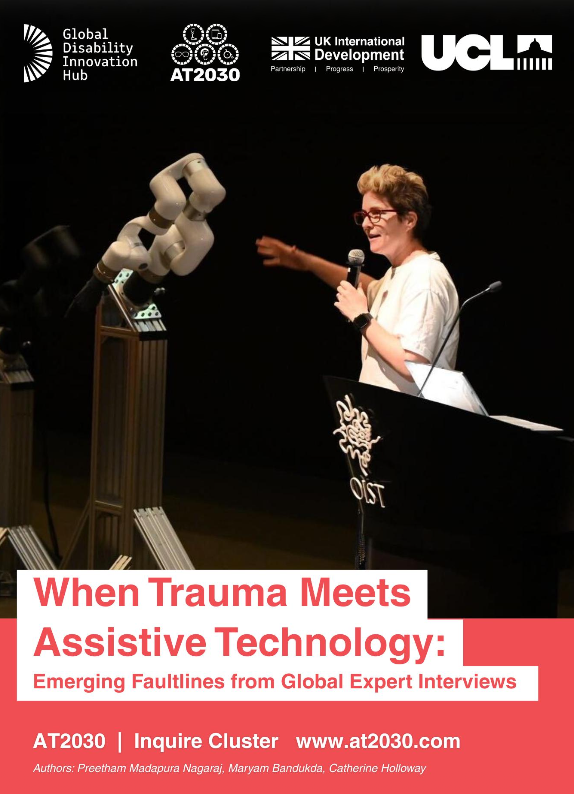
When Trauma Meets Assistive Technology: Emerging Faultlines from Global Expert Interviews
Preetham Nagaraj, Catherine Holloway, Maryam BandukdaMarch 18, 2026GlobalAcademic Research PublicationsAssistive Technology (AT) has largely been designed around needs that, even when they change over time, are relatively predictable; yet trauma produces disruptions that are rapid, context-dependent, and culturally mediated. This paper asks: what conceptual tensions emerge when trauma recovery technology is viewed through an AT lens, and what do those tensions reveal about the limits and future direction of the field?
-
Ndingathe I'MPOSSIBLE Teacher Handbook
Malawi Paralympic CommitteeMarch 17, 2026MalawiAT2030 ResourcesInternational Paralympic Committee’s I’MPOSSIBLE education programme was first introduced in Malawi in 2019 through implementation by the Malawi Paralympic Committee. The programme aimed to use the power of Paralympic sport and athlete storytelling to challenge perceptions of disability and promote inclusion through sport and physical education. Developed by the Malawi Paralympic Committee in close collaboration with the University of Malawi, this tool is intended to support more independent and widespread use by teachers, schools, and community organisations across the country.
-
Bridging the Digital Divide: Enhancing Digital Inclusion of Blind or Partially Sighted and Deaf or Hard of Hearing Individuals in Low- and Middle-Income Countries through Smartphones as Assistive Technology
Vicki Austin, Catherine Holloway, Dr Giulia Barbareschi, Laxmi Gunupudi, Vinicius Delgado Ramos, Satish Mishra, Maryam Bandukda, Amit PrakashMarch 17, 2026GlobalAcademic Research PublicationsIn this study, we developed a two-day scaffolded digital skills training intervention for mobile literacy for people who are blind or partially sighted (BPS) and deaf or hard of hearing (DHH) across three research settings: Brazil, India, and Kenya. Using an adapted Mobile Device Proficiency Questionnaire (MDPQ) administered at pre- and post-intervention, we measured the impact of the digital skills training intervention on the perceived proficiency in smartphone use.
-
When Sport Opens a Door: Reflections on disability, stigma and Para sport in Malawi
Loughborough UniversityMarch 17, 2026MalawiAT2030 ResourcesStories about disability and sport are often told through moments of success or celebration. This conversation between Timveni Radio and TV journalist Mphatso Mnelemba and sitting volleyball player and fashion designer Callista Mdumuka offers something different. Through reflections on school, gender, disability, sport, stigma and everyday life, the discussion reveals both the hope and uncertainty that can shape participation in para sport in Malawi. It is also a conversation that highlights the role journalists and storytellers can play in creating space for experiences and voices that are often overlooked.
-
Supporting the support systems: Integrating assistive technology access into aging policy frameworks
Jamie Danemayer, Catherine Holloway, Vicki Austin, Shereen HusseinMarch 12, 2026GlobalAcademic Research PublicationsIndividuals who can obtain and effectively use assistive products, such as wheelchairs, hearing aids, and accessible software, are understood to have reliable access to assistive technology (AT). Such access is increasingly recognised as critical support in the context of global population ageing, where the prevalence of functional difficulties is rising and the demand for supportive solutions and services is expanding. In response, AT outcomes such as need, use, and unmet need are more often included in routine data collection systems, including censuses and household surveys. Similarly, dedicated surveys, such as the WHO Rapid Assistive Technology Assessment (rATA), have been successfully administered in dozens of countries, expanding the portfolio of available AT data.
-
Integrating disability related data into national Health Management Information Systems
Global Disability Innovation Hub, Clinton Health Access InitiativeMarch 3, 2026AT2030 ResourcesThe AT2030 programme tests ‘what works’ to improve access to Assistive Technology (AT) and will invest £20 million over five years to support solutions with a focus on innovative products, new service models, and global capacity support. The programme will reach nine million directly and six million more people indirectly to enable a lifetime of potential through life-changing AT. The programme is funded by UK aid and led by the Global Disability Innovation Hub. Under Cluster 3: Country Implementation of the AT2030 programme, CHAI is partnering with country governments of Liberia and Sierra Leone to drive access to AT by improving disability data availability. Below is a case study of one such piece of work
-
Unlocking Investment in Assistive Technology: Blended Finance and the Path to Market Scale
Global Disability Innovation HubFeb. 25, 2026GlobalCase Studies and ReportsAssistive technology — such as wheelchairs, hearing devices, glasses and communication tools — enables disabled people, older adults and others with support needs to participate fully in society. More than 2.5 billion people need AT, yet fewer than one in seven can access it. The issue is not a lack of demand or innovation, but a lack of suitable finance to help effective solutions scale. This report argues that blended finance can unlock the AT market by combining philanthropic, public and private capital to reduce risk and attract investment. Drawing on ten years of GDI Hub research and engagement with more than 150 AT ventures, it sets out practical recommendations to expand access globally. The pipeline exists, the mechanisms are available, and the opportunity is within reach.
-
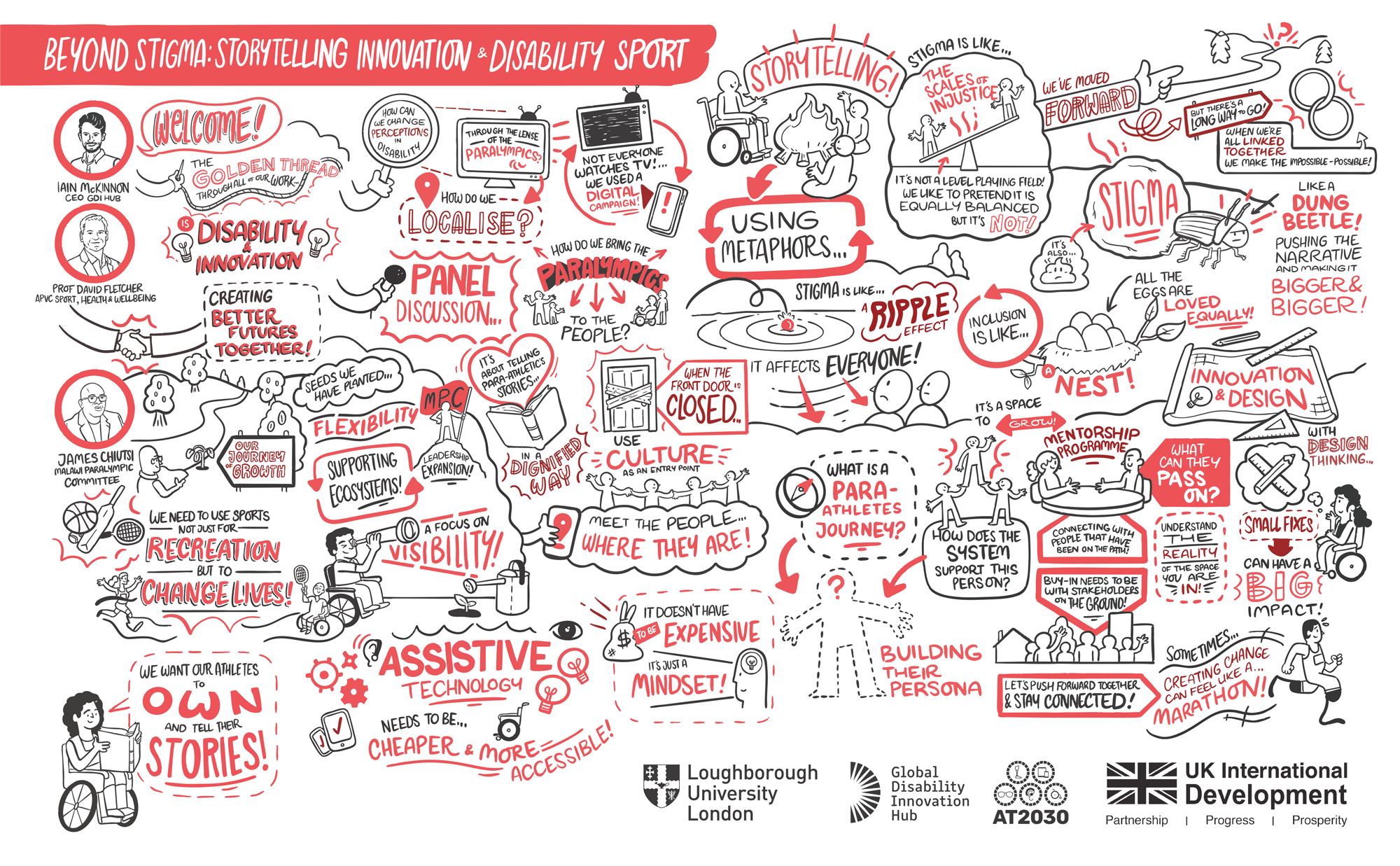
Beyond Stigma Workshop - ideas, learning and sharing
Loughborough UniversityJan. 27, 2026Case Studies and ReportsThe Beyond Stigma knowledge sharing workshop created a conversation that moved beyond awareness or attitude to focus on how stigma is produced through systems, and what that means for efforts to address it. Capturing reflections, experiences and learnings from the AT2030 Para Sport Against Stigma programme, the event provided an opportunity to step back and reflect - as is captured by the visual illustration of the disussions.
-
OPD Country Level Strategy for Kenya
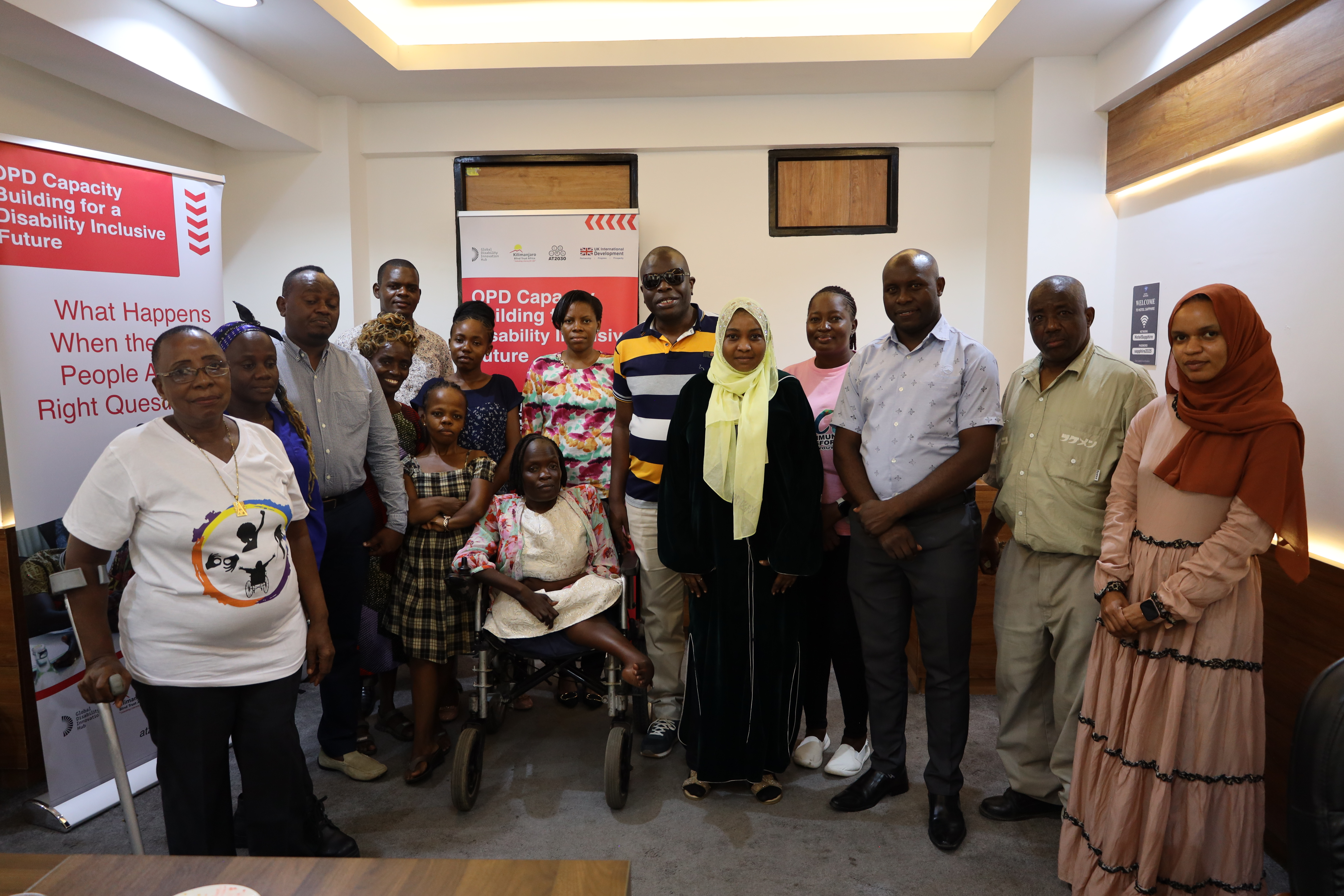
Global Disability Innovation HubDec. 19, 2025KenyaAT2030 ResourcesThe primary aim of this project is to develop an OPD Country Level Strategy for Kenya, titled: ‘How can technology support OPDs to build capacity, impact and influence’ - through a lens of Assistive Technologies which will include an OPD Capacity Building Framework co-created by OPDs.
-
Communication for Localisation: “Making” the Paralympics Malawian
Jennie Wong, Prof. Mufunanji Magalsi (UofMalawi), Jo Tacchi, Jessica Noske-TurnerNov. 27, 2025MalawiAcademic Research PublicationsLike many media and communication initiatives for development and social change that are highly global in nature, the social impact of expanding the broadcast footprint of the Paralympic Games to regions such as sub-Saharan Africa is often simply assumed, and the markers of success are underpinned by a reach-centric logic. In this paper, we explore whether and how the Paralympics can become a platform for social change. Informed by findings from a four-year participatory action research project, this paper analyses experimentation with different communication for social change approaches related to para sport and the Paralympics, with a focus on Malawi.
-
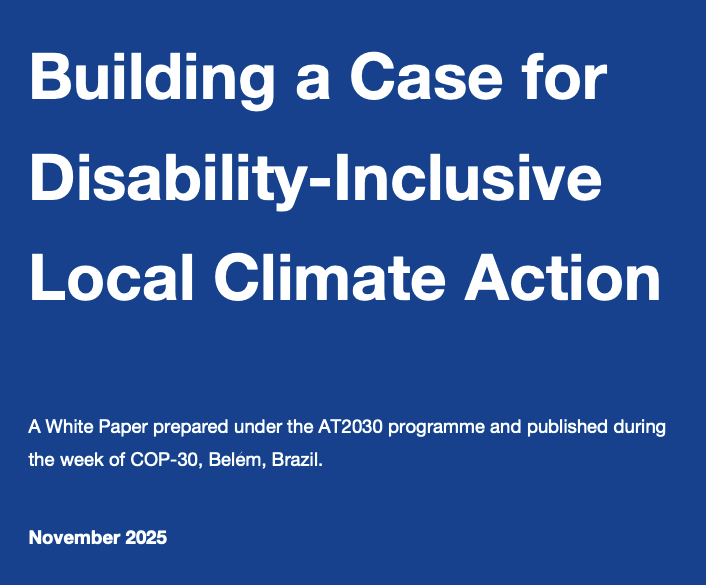
Building a Case for Disability-Inclusive Local Climate Action.
Global Disability Innovation Hub, Mikaela Patrick, Bala NagendranNov. 21, 2025GlobalAT2030 ResourcesThe Global Disability Innovation Hub (GDI Hub) presents this White Paper titled ‘Building a Case for Disability-Inclusive Local Climate’ as an effort to synthesise available insights at this intersection and frame a narrative for future research, innovation, and action.
-
Empowering Mobility in Kenya: The Journey So Far
Harrison KamauOct. 25, 2025KenyaCase Studies and ReportsOver the past year, we’ve built a consortium of innovators, including MATT from Colombia, NeoMotion from India, EbikesAfrica, TAI (The Accessibility Institute) and Kounkuey Design Initiative from Kenya. Each partner has contributed insights from their respective markets and communities. This global exchange of ideas, supported by the Global Disability Innovation Hub (GDI Hub) and the AT2030 programme, positioned us to launch practical trials in Kenya.
Previous PageNext Page