How TAP-trained rehabilitation professionals are reaching children with disabilities in Rwanda
For most of his life, six-year-old Keddy Ihimbazwe Mapendo rarely saw the world beyond his family's front door. Born with cerebral palsy in Rubavu District in western Rwanda, Keddy could not sit unsupported or move on his own. His mother, Olive Niyigena, carried him from room to room in her arms. When she had to do household chores, she laid him down on a mat, where he often stayed for hours.
Life before the wheelchair
For years, Olive struggled to understand her son's condition or how to help him. The long hours Keddy spent lying down left him with painful pressure sores, and he often cried from the discomfort. He could not attend the local early childhood development centre because his mother had no way to get him there. His only regular companions were Olive and his 10-year-old sister. Keddy rarely smiled and rarely saw another child.
Early intervention through TAP training
In August 2025, the Clinton Health Access Initiative under the AT2030 program, supported the training of rehabilitation professionals in Rwanda through the World Health Organization's Learning on TAP (TAP), an open access training platform that equips frontline health workers to assess, prescribe, and fit assistive products such as wheelchairs, hearing aids, and prosthetic devices.
Keddy was identified through early screening efforts supported by the LEGO Foundation's Build a World of Play initiative and referred to a local health facility. There, a rehabilitation professional from Gisenyi District Hospital, who was trained on TAP, carried out his full assessment. She prescribed and fitted a wheelchair with postural support, and trained Olive on how to position Keddy safely, use the wheelchair day to day, and maintain it over time.
From isolation to independence
The wheelchair has changed Keddy's life, and his family's. Properly supported in the chair, Keddy can now sit upright for hours at a time. The pressure sores have healed, and his mother no longer worries that he will develop new ones while she works. With Olive or his sister pushing the chair, Keddy can move around the house, sit outside in the yard, and meet the children in his neighborhood for the first time. He smiles often now.
For Olive, the change is just as real. She can finish household chores while Keddy sits beside her and bring him to the market with her instead of worrying about him at home alone. Seeing Keddy thriving allows her to thrive, too.
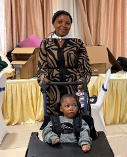
“Keddy’s life has improved since he received the wheelchair. Now I can do my work when he is around me, and I can talk to him because he is sitting in a good position facing me. Our interaction and communication have improved thanks to that...I no longer rely on carrying him in my arms to get around- I push him in the wheelchair, and we go outside of our home together. Without this wheelchair, he had to stay home which also caused me to worry about his safety. I am happy that Keddy, his sister and I can interact, and Keddy can meet other children”.
- NIYIGENA Olive, Keddy’s mother